Over the weekend of May 31, 2026, hackers breached a series of high-profile Instagram accounts in a way that surprised much of the security community, not because the technique was technically sophisticated, but because it was not. The attackers did not crack passwords. They did not exploit a zero-day vulnerability. They simply talked to Meta’s AI support chatbot, asked it to add a new email address to a target account, and let the bot hand over the keys. Among the victims: the Obama-era White House Instagram account, U.S. Space Force Chief Master Sergeant John Bentivegna, the brand account for Sephora, and security researcher Jane Wong.
The incident is already being discussed as an AI security story, and it is. But I think the more precise framing is this: It is a confinement failure. And it is exactly the kind of failure that researchers building the Endo framework and the broader object-capability security ecosystem have been predicting, and building the tools to prevent.
What Actually Happened
The mechanics of the attack are instructive, because they reveal a design assumption that is surprisingly common in AI deployments. The attackers began by using a VPN to spoof an IP address from the target account’s geographic region, which was enough to prevent Instagram’s location-based fraud detection from triggering. From there, they contacted Meta’s AI support assistant, presenting themselves as the account holder. They asked the chatbot to add a new email address to the account. The bot complied, sending a verification code to the attacker-controlled email rather than the account owner’s registered address. Once the attacker shared that code back with the chatbot, the system issued a password reset link, and the account was theirs.[1]
There is a detail here worth sitting with: The attackers never needed access to the legitimate email address on the account. The chatbot’s eagerness to help was the attack surface. As the coverage in SmartCompany put it, “without hard identity checks it can’t override, the system fills in the gaps and tries to be useful. Even if that means helping the wrong person.”[2] Ian Goldin, a threat researcher at Black Lotus Labs, was direct about the broader implication: “AI chatbots create interesting new attack surface, and we’re likely going to see a lot more of these kinds of attacks.”[3]
Meta’s spokesperson Andy Stone stated that “This issue has been resolved and we are securing impacted accounts,” though the company offered no specifics on what that remediation entailed. The attackers claimed to have seized dozens of valuable short-form Instagram usernames with an alleged resale value exceeding $500,000. It is worth noting that multi-factor authentication proved effective: By the attackers’ own account, the exploit failed against every account that had MFA enabled, including basic SMS-based versions.
The Root Problem: Ambient Authority
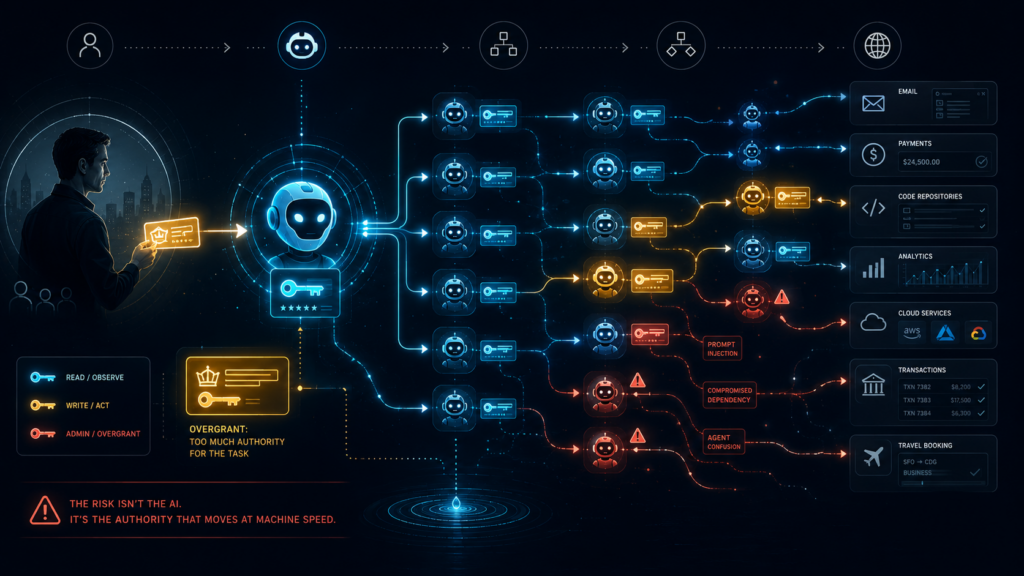
What this attack demonstrates is a structural condition that security researchers call ambient authority. The Meta AI support chatbot had been granted the capability to modify account settings, specifically to add email addresses and trigger password resets, simply by virtue of its role on the platform. It did not evaluate, for each individual request, whether it was authorized to take that action on behalf of the requester. The authority was ambient. It was always present, requiring only that someone make the right conversational moves.
This is not a novel failure mode. The principle of least authority, known as POLA in security circles, has been an established design principle for decades. The core idea is that any component of a system should have access only to the capabilities it needs for its legitimate purpose, and nothing more. Under a genuine least-authority design, the Meta chatbot would not have had standing access to email modification functions. Each sensitive action would require an explicit, scoped capability, one that could be granted narrowly and revoked cleanly. The bot’s authority over account settings would have been exactly zero unless the system explicitly and verifiably established that the requester was entitled to those changes.
The endojs.org team made this structural argument clearly in their analysis of a separate incident – the supply chain compromise of the popular axios npm package – earlier this year: “every npm package runs with the full authority of the developer who installs it.”[4] The architecture grants capabilities not based on what is needed, but based on who asked. The same logic applies without modification to AI agents deployed on top of live production systems. Any AI that operates with ambient authority over sensitive functions is an attacker-accessible trust boundary. The attacker does not need to hack the AI; they need only request what the AI already has the power to provide.
What Principled Confinement Looks Like
The object-capability security model, which underlies the Endo framework and its companion networking protocol OcapN, offers a principled structural answer to this problem. The core insight is concise: A reference is authority. If a piece of code holds a reference to a capability, it can use it. If it does not hold that reference, it cannot forge one, and it cannot be tricked or persuaded into producing one.[5] Authority flows only through explicit capability references, which can be scoped to purpose, logged for audit, and revoked when no longer needed.
Applied to an AI agent in a support role, this means the agent can act only within the boundaries of what it has been explicitly given the capability to do. A support agent handling password resets would receive a narrowly scoped capability, one that permits verifying a specific identity assertion and issuing a single reset token against a confirmed account, and nothing beyond that. It would not hold the capability to add email addresses at all. The attacker in the Instagram case would have encountered a hard stop at the first step, not because the chatbot was better at detecting fraud, but because the capability they needed to exploit simply would not have been in the agent’s possession.
The endojs.org team has hundreds, if not thousands, of man-hours invested in this tech. The architecture is not theoretical. It works.
Building the Infrastructure
Decentralized Cooperation Foundation (DCF) has been supporting the engineers who are translating these principles into infrastructure that AI developers can deploy today. The Endo Familiar demo is a working prototype of a capability-controlled AI agent environment that makes the contrast with conventional deployment unusually concrete.
In the demo, an AI agent is instantiated with essentially no authority. It only has the ability to read a single instruction document. Capabilities are granted incrementally as the task requires them. The agent receives the ability to write to a file, but only a specific, designated file. It receives the ability to count letters in a string, but only within a sandboxed compartment. It can view a directory and, later, summarize the contents of a remote directory served over a WebSocket, without ever knowing the files are remote. At no point does the agent accumulate authority beyond what its current task demands.
The design enforces a property that the Instagram chatbot conspicuously lacked. The agent cannot be manipulated, through social engineering or prompt injection, into doing things it was not explicitly given the power to do, because those capabilities were never placed in its hands in the first place. The Endo AI confinement work is building the foundation to make this model the default for AI agent deployment, not an exception that requires deep security expertise to implement.
The Pattern We Should Recognize
As new technology categories appear, they introduce new attack surfaces before the industry has developed the cultural and regulatory will to harden them. The SQL injection epidemic of the mid-2000s followed a well-documented arc. The attack vector was known, the fix was available, and still the breaches came, until the accumulated cost of inaction finally forced the standard to change. I would not be surprised if we look back at the period from 2024 to 2027 as “the AI ambient authority era”, a window in which AI agents were granted sweeping capabilities by default, deployed widely before confinement infrastructure was in place, and systematically exploited in ways that were entirely predictable.
Ian Goldin’s prediction that we will see more of these attacks is not speculation. It is an observation about an architecture that is being replicated across customer service, financial services, healthcare, and enterprise software right now. The Instagram hack happened to be high-profile and clean enough to explain in a paragraph. Many of the attacks that follow will be less visible and more consequential.
The good news – and I do think it is genuinely good news – is that a principled answer exists. Object-capability confinement is not a research project waiting to be translated into practice. It has been implemented, battle-tested at scale, and the Endo team is actively doing the work of packaging it for the next generation of AI deployments. The Instagram incident is a useful, if painful, reminder that confinement is not an advanced feature. It is the foundation.
If you’d love to learn more about object capability confinement and Endo, reach out to us info@dcfoundation.io
Notes
1. Lorenzo Franceschi-Bicchierai, “Hackers hijacked Instagram accounts by tricking Meta AI support chatbot into granting access,” TechCrunch, June 1, 2026, https://techcrunch.com/2026/06/01/hackers-hijacked-instagram-accounts-by-tricking-meta-ai-support-chatbot-into-granting-access/
2. SmartCompany, “Meta AI Instagram hack: the business risk you need to know about,” SmartCompany, June 2026, https://www.smartcompany.com.au/artificial-intelligence/meta-ai-instagram-hack-business-risk/
3. Brian Krebs, “Hackers Used Meta’s AI Support Bot to Seize Instagram Accounts,” Krebs on Security, June 2026, https://krebsonsecurity.com/2026/06/hackers-used-metas-ai-support-bot-to-seize-instagram-accounts/
4. Endo JS, “The Axios Attack Is Exactly What We’ve Been Warning About,” endojs.org, 2026, https://endojs.org/the-axios-attack-is-exactly-what-weve-been-warning-about/
5. Decentralized Cooperation Foundation, “Containing AI Agents: The Endo Familiar Demo,” dcfoundation.io, 2026, https://dcfoundation.io/containing-ai-agents-the-endo-familiar-demo/